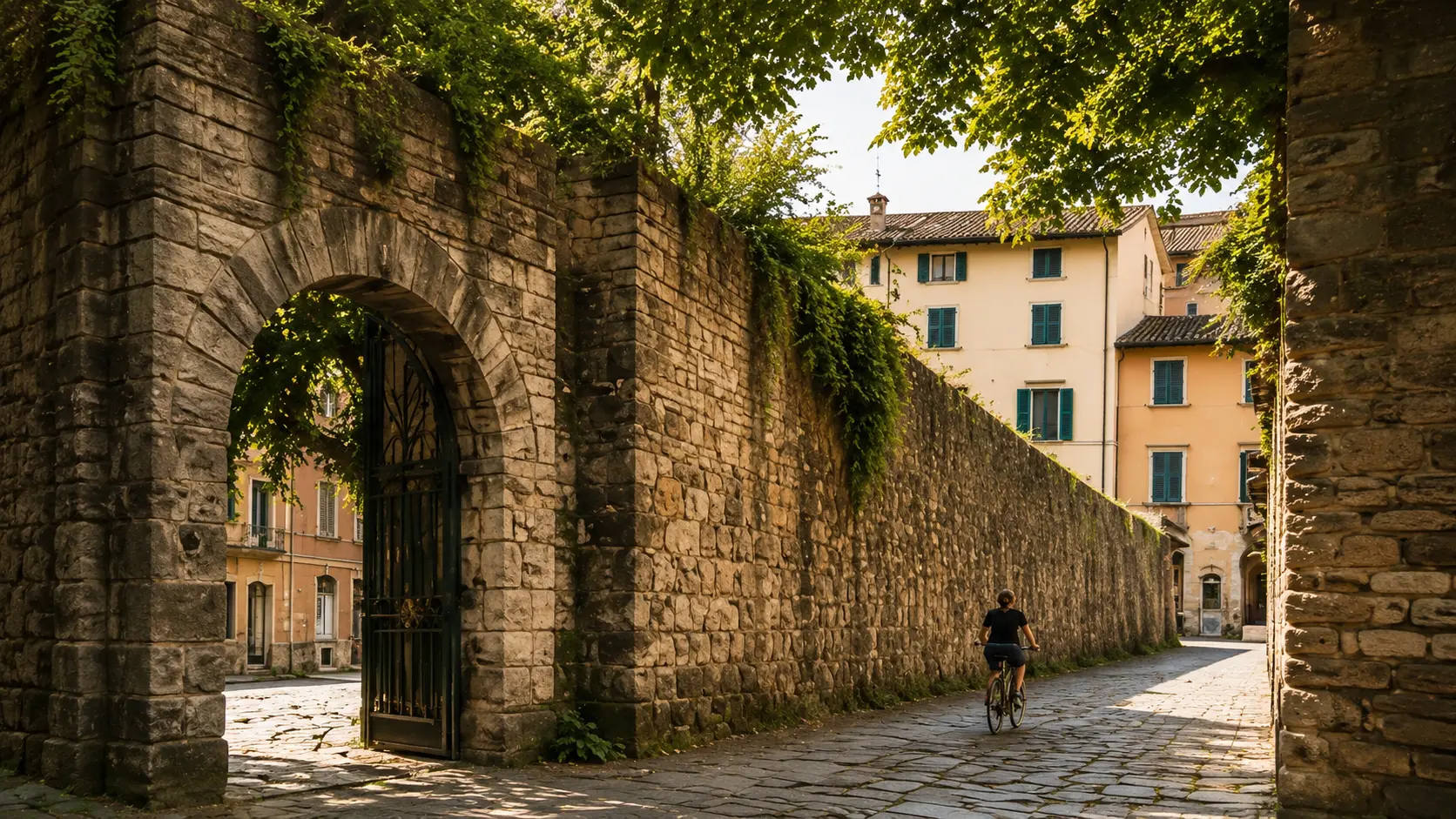
Everyone keeps calling seven weeks in Italy a vacation, which is adorable.
A vacation is what happens when you leave your actual life at home. We are bringing ours: school, work, therapy, tennis, Italian lessons, my mother, all three children, and the usual machinery required to keep everyone educated, moving, and reasonably pleasant. We are simply relocating the whole production inside the walls of Lucca.
A couple of years ago, I could not have planned this far ahead. There were too many questions about what Astrid’s body would be able to do, what my own health would require, and what the next appointment might change. For a while, our calendar reached only as far as the next answer.
Things are different now.
Astrid is walking. Therapy is still part of our life, but it can come with us. My surgeries are behind me. The news has been good. The boys can take school with them. Work can travel too. Somewhere along the way, planning beyond the next appointment began to feel possible again.
So we are going to Lucca.
Not because we need seven weeks of vacation. I would not know what to do with seven weeks of vacation. I want the part of Italy that begins after the itinerary runs out.
We are going now because, for once, we can stay.
THE TEN-DAY FORMULA
We are very good at leaving.
We travel often, but rarely for long. Ten days is our formula: two weekends and the workweek between them. Long enough to go far. Short enough that work, school, and Astrid’s therapy can absorb our absence.
Since ten days has always felt generous, we usually divide it between at least two places. We arrive with dinners booked, cover an unreasonable amount of ground, and leave just as we stop needing the map.
We have spent years perfecting the highly efficient American art of returning from abroad in need of a vacation.
This time there is no second city waiting. We can let one place become familiar.
THE APARTMENT HUNT
For three nights, a room needs to be lovely. For 47, I need to want to come home to it.
Which is where my particularity becomes relevant. I notice hotel rooms in ways that are not always useful to the people traveling with me. I notice the bedding. The smell. The grout. The air vents. Whether I actually want to sit on the sofa. My mother finds this exhausting. She is correct.
People I worked with knew that my business-trip luggage sometimes included my own sheets and cleaning supplies. They found this comical. I found it easier than wondering. I do not pack that way now. I research until I do not have to.
I found three brand-new apartments in a restored building on Lucca’s main piazza. They are immaculate, beautifully designed, and priced at roughly five times the closest alternatives with comparable space, amenities, and location.
The one I want has hand-painted ceilings, a kitchen I already know how to use, and a balcony over the piazza. If Astrid is asleep, I can step outside and still feel part of the evening below.
Some of the alternatives have balconies too. The problem is that this apartment has made all of them feel like alternatives.
There were almost no reviews because the apartments were new, so I researched the designer instead. I looked at her other work, the materials, the details, and the standard she seems to consider normal. I wanted to know whether the apartment was genuinely as good as it looked or merely very good at being photographed.
Part of the appeal is embarrassingly simple: everything is new. I would not spend the first evening evaluating the sofa. I would sit on it. That is not the grandest argument for paying more, but it is an honest one.
Two months before our arrival, every night we needed was available.
When I was in business school, I won an award for negotiation. Decades later, I still wear it like a badge of honor. I entered this negotiation with confidence. The apartment has been unimpressed.
I offered roughly two-thirds of the asking price. I did not pull the number from the Tuscan air. Their own shorter-stay promotion reduced the extra nights to roughly the nightly rate I proposed for the full stay.
They came back with only a small reduction.
The apartment knows what it has.
Housekeeping was not included. I had already found a reputable local provider for a daily refresh. Their preferred service cost roughly five times more. I offered to use it anyway, on top of my offer. If the owners were less moved by 47 occupied nights than by keeping their brand-new apartments pristine, I was willing to make that argument too.
It did not move them.
They did eventually say they would meet our number—if we came in November. Apparently the apartment becomes considerably more reasonable when we are not there to enjoy September.
Now we are two weeks from leaving, and every night we need remains unbooked.
I keep checking.
It has become a private ritual: open the calendar, confirm that no one has booked it, feel briefly vindicated, then wonder whether I should pay more.
Maybe the owners are waiting for me to call my own bluff. They know what they have. They may also know that I know it.
The alternatives are attractive, central, comfortable, and rational. The expensive apartment is newer, more beautiful, and more certain.
I do not need hand-painted ceilings to enjoy Lucca. I do need to feel at home when I close the door.
The thing I may be trying to buy is not luxury so much as relief from my own attention to detail—a place I can stop evaluating and simply live in.
Which leaves the slightly inconvenient question: the calendar is still mostly empty. They still won’t take my offer. I still want the apartment. If the market is not validating the premium, why am I so tempted to?
There is a difference between not knowing you are overpaying and knowing perfectly well—and deciding you want the thing anyway.
At this point, the apartment is not negotiating with me.
I am negotiating with myself.
THE PLAN, SUCH AS IT IS
- 47
- days
- 3
- generations
- 3
- children
- 2
- teenagers still in school
- 1
- toddler still in therapy
- 4
- people learning Italian
Four of us are taking Italian. Citizenship is part of the reason. My mother has no such requirement, but she is taking the class with me anyway.
Plus tennis, cooking, chess, work, research, groceries, café stops, beach days, good dinners, and whatever we haven’t thought of yet.
Stay long enough that none of this feels noteworthy anymore.
DISPATCHES FROM LUCCA
What we notice when tomorrow stops needing an itinerary.
I want to stay long enough for the boys to stop waiting for me to make the plan. For my mother to acquire a favorite morning. For our Italian to become useful enough to fail us in more interesting ways. For Astrid to move through a city built at a very different scale from home.
There will be beautiful days. The ordinary ones may tell us more.
Not everything we do. Only the things worth looking at twice.

FOLLOW STORY 01
The unfolding version lives on Instagram.
The apartment, the Italian, the school mornings, the things that work—and the things we change our minds about.
Follow @drifted.northWHAT BECOMES PART OF A LIFE, MATTERS.
What we’re taking home.
Not literally. Necessarily.
Nothing yet. Forty-seven days to find out what belongs here.