The Complete Guide to Light Therapy: Home vs. Clinic.
We reviewed 128 devices, treatments, and supporting entries. Can a home device deliver the skin improvement you want—or is a clinic treatment worth the recovery? Compare the findings for fine lines, texture, deep wrinkles, and lost facial fullness, then choose the routine you can sustain.
Light therapy, home devices, and the clinic alternatives.
Why we looked closer.
I already own a LYMA. I use it for scars, skin, and selected wrinkle areas, and I have seen changes in my scars and loose postpartum skin. But I have not been able to commit consistently to a full-face routine, so I haven’t seen as much improvement in my facial wrinkles as I’d like. Now I’m wondering: do I need to bite the bullet and go into a clinic, even if it means downtime—or could a more efficient full-face mask or panel deliver the improvement I’m looking for?
Investigating felt like entering a maze. Every device seemed to report a different result, measured differently, after a different routine. I wanted to know what works best, why it earns a place, and whether results at home could make a clinic procedure unnecessary. We reviewed 128 devices, treatments, and supporting entries across home and clinic options, keeping the result, commitment, and study behind each choice together.
Why we looked closer
I already own a LYMA. I use it for scars, skin, and selected wrinkle areas, and I have seen changes in my scars and loose postpartum skin. But I have not been able to commit consistently to a full-face routine, so I haven’t seen as much improvement in my facial wrinkles as I’d like. Now I’m wondering: do I need to bite the bullet and go into a clinic, even if it means downtime—or could a more efficient full-face mask or panel deliver the improvement I’m looking for?
Investigating felt like entering a maze. Every device seemed to report a different result, measured differently, after a different routine. I wanted to know what works best, why it earns a place, and whether results at home could make a clinic procedure unnecessary. We reviewed 128 devices, treatments, and supporting entries across home and clinic options, keeping the result, commitment, and study behind each choice together.
The answer first
The instant verdict.
For mild fine lines and skin texture, a consistent home routine can be a worthwhile alternative to a clinic course. Some reported home improvements are substantial; the studies do not establish that a home device matches or beats resurfacing. For deep etched wrinkles, seek a clinic assessment. For lost facial fullness, light therapy does not replace a volume-restoring treatment.
Background: what changes the answer?
The concern comes before the device.
Fine lines and rough texture are surface concerns that may respond to home light treatment. Deep etched wrinkles, movement-driven lines, lost facial volume, and tissue descent can need different approaches. Smoothness, wrinkle depth, wrinkle volume, and an appearance grade measure different changes.
This is a guide to home light therapy, with clinic treatments as a reference for the result and recovery you might choose instead. Masks, panels, and cold lasers use non-thermal light; resurfacing lasers deliberately heat tissue. Peptides, electrical devices, fillers, and surgery are supporting comparisons.
How to read the comparison: a larger percentage from a different study is not proof of a better treatment. The table keeps the clinic finding and the home finding together, then states what we can conclude.
Start with your concern. These are selected findings, not a claim that the largest percentage wins across different studies. Purchase links are provided where a current US route is established; clinic links open the supporting results.
Clinic and home findings by concern. No reviewed direct trial establishes that the listed home devices match or exceed the listed clinic procedures.
Your concern
Clinic benchmark / commitment
Home contenders / commitment
What this means for your choice
Fine lines / physical wrinkle depth
Fractional CO₂: 51.3% lower cheek depth; 31.1% lower eye-area depth after three treatments. Initial healing often 1–2 weeks per visit.
LYMA: reported 53.8% lower depth after five weeks of twice-daily laser-plus-skincare use; substantial hands-on time. Shop LYMA. OVE: 38.3% lower crow’s-foot depth after 84 days; 12 minutes twice weekly, outlet required. US delivery/support unresolved.
LYMA’s reported number is numerically higher than the selected cheek result, but the studies do not establish equal or superior effectiveness. Home is a credible route if the routine fits; CO₂ offers a finite professional course with healing.
Texture / smoothness
Fraxel DUAL: 30% roughness-grade improvement and 21% fine-wrinkle severity improvement; up to four visits. Redness/swelling resolved within 7–10 days in the study.
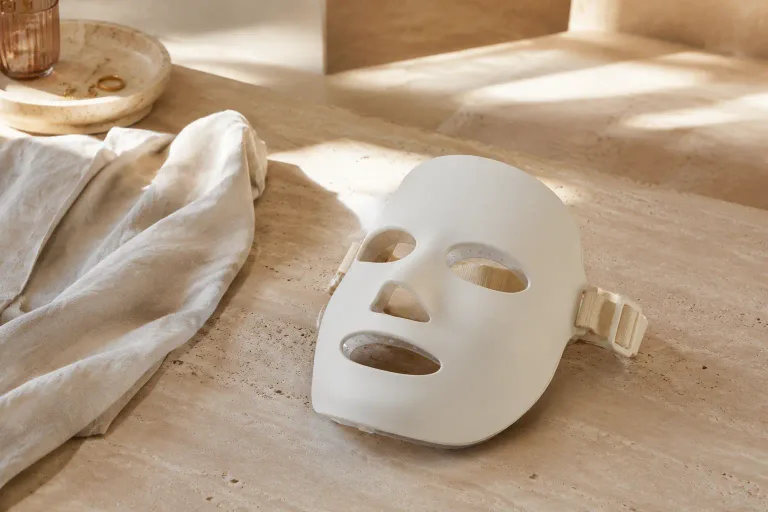
Omnilux Contour Face: 38.7% improvement in smoothness score and 37.6% in wrinkle number/width score; ten minutes three times weekly for four weeks. Battery controller, with a mask cable; zero downtime. Shop Omnilux.
Both report surface improvement. 38.7% smoothness and 30% roughness grade are different scales: Omnilux has not demonstrated that it outperforms Fraxel. A mask offers a low-disruption routine; resurfacing brings a procedure course and recovery.
Fine lines / mobile wearable
The CO₂ finding above is a resurfacing reference, not a wearable-mask comparison.
CurrentBody Series 2: forehead depth 14.10% lower and wrinkle volume 29.80% lower after eight weeks. Ten-minute sessions; unplugged from the wall, with a controller cable. Zero downtime. Shop CurrentBody — select Series 2.
A practical wearable contender when you want physical depth and volume measurements. Regional findings are not a whole-face result or proof of superiority over Omnilux. Use the mask table to compare each outcome separately.
Deep etched wrinkles
Professional assessment can distinguish resurfacing needs from movement-driven lines or creases caused by lost volume. Treatment and recovery depend on that cause.
LYMA and masks have wrinkle findings, but the headline studies shown here do not establish correction of severe etched wrinkles. No home substitute is demonstrated for that target.
Fillers, collagen-stimulating injectables, and fat transfer address different volume-restoration needs. These are not light-therapy treatments.
No reviewed light device demonstrated restoration of lost facial fat or bone support. Wrinkle-volume reduction means a smaller crease, not more facial fullness.
Open the alternatives for the result, price, routine, and study behind each choice. Clinic details sit beneath the home picks.
Fine lines
Our assessment
LYMA has the largest reported home physical-depth reduction in this review: 53.8% after five weeks of twice-daily laser-plus-skincare use. That is why it leads the handheld depth choice; it does not make it the proven best treatment for every skin outcome.
For a mask, the strongest reported physical-depth result is OVE: 38.3% lower crow’s-foot depth overall after 84 days, with a stationary mains-powered routine. For measured depth and volume in an unplugged wearable, CurrentBody Series 2 deserves the first look. Its SGS study reported forehead depth 14.10% lower and wrinkle volume 29.80% lower; crow’s-foot depth was 8.03% lower.
Omnilux is our lower-cost practical choice for smoothness and fine-line score, not the largest demonstrated depth reduction. Easy Claire offers a strong sham-controlled responder finding. The ranked mask comparison separates each outcome. If I cannot sustain a full-face handheld routine, I would choose the mask whose result and format I will actually use.
Clinic resurfacing can produce substantial correction, but no reviewed direct LYMA-versus-mask-versus-resurfacing trial establishes which delivers more for the same person. Open the clinic comparison when the home findings do not answer your concern.
At home
Our home choice for reported wrinkle-depth reduction
LYMA Laser
Why we favor it. The largest reported home wrinkle-depth reduction in our review, with zero downtime.
Reported result53.8% lower after five weeks of twice-daily laser-plus-skincare use, reported by LYMA.
Price · USD
$2,695 original / $5,995 PRO
Treatment time & course
3 minutes per held area. The five-week result used twice-daily treatment; current guidance starts with daily use for 12 weeks.
Recovery
Zero downtime.
Jude’s LYMA experience
Because it’s portable, I find it easier to tackle problem spots while waiting in the car on school or activity runs. A few small areas fit my life much more easily than a full-face routine.
Study details
Substantial hands-on time. You must hold or move the laser across each area; a full-face routine takes much longer than treating one small patch. PRO covers more skin at once, at a higher price.
The 53.8% figure is a brand-reported result for the laser-plus-skincare regimen. The complete facial trial protocol and participant count were not available in the public material reviewed. No direct home-versus-clinic comparison or separate PRO-specific effect size was established.
Which wearable mask? CurrentBody Series 2 for measured depth and volume; Omnilux for lower-priced smoothness and fine-line-score results. OVE leads the reported mask depth findings but requires a seated, plugged-in routine. Rank every reviewed mask by outcome and power format.
Lucibel·le Paris OVE LED maskOur hands-free choice for reported wrinkle-depth reduction
Our hands-free choice for reported wrinkle-depth reduction
Why we favor it. The largest reported mask physical-depth reduction in our review, with two sessions a week. Mains-powered and stationary; you sit at the supported array.
Reported result38.3% lower crow’s-foot overall; 43.5% in the female subgroup after 84 days.
Price · USD
From approximately $1,670 / converted manufacturer price Price source
Treatment time & course
12 minutes, twice weekly for 12 weeks.
Recovery
Zero downtime.
Study details
Higher cost and a stationary routine: you sit at the supported array. A current US delivery route and US support terms were not confirmed, so it is an investigate-before-importing option rather than our easiest US buy.
The original GREDECO report includes 20 participants: 15 women and 5 men. The 38.3% pooled result and 43.5% female-subgroup result belong to the same study, also reported in the Dior/Lucibel publication. This was an industry-commissioned before/after study without control; exact current-model mapping remains in the evidence library.
Lower-priced alternative with a strong controlled finding
Why we favor it. A randomized, double-blind comparison found substantially more people improved with the active mask than with . Its verified Korean retail listing costs less than OVE.
Reported result86.2% improved at least one crow’s-feet , versus 16.7% with , at 12 weeks.
Price · USD
Approximately $1,110 / converted Korean retail listing Price source
Treatment time & course
9 minutes, 5 times weekly for 12 weeks.
Recovery
Zero downtime.
Study details
More sessions each week than OVE. The verified price is from Korea. CeraDerma advertises international shipping but currently marks this mask sold out; an in-stock US delivery route was not confirmed. It costs more than Omnilux.
60 enrolled; 59 in the full analysis set. Independent blinded raters scored crow’s feet; 25 of 29 active users and 5 of 30 users improved at least one grade. This counts s, not the percentage reduction in , so it cannot be ranked numerically against OVE’s 38.3%. Manufacturer-funded trial. GS SHOP listed the face mask at KRW 1,490,000 when checked November 3, 2026; conversion uses November 2 ECB rates.
Why we favor it. Its exact Series 2 SGS course measured both physical depth and across facial regions; the battery controller lets the mask run unplugged from an outlet.
Reported resultForehead depth 14.10% lower and 29.80% lower; crow’s-foot depth 8.03% lower and volume 25.74% lower at eight weeks.
Price · USD
$469.99 / face device
Treatment time & course
Ten-minute sessions; follow the exact Series 2 course and current instructions.
Recovery
Zero downtime.
Study details
A cable still connects the mask to its rechargeable controller. This is a regional study, not proof of superiority over Omnilux or OVE.
35 completers in a commissioned SGS before/after study. The largest regional result is not a whole-face average. A separate face/neck study measured facial depth 9.48% lower and neck depth 9.03% lower after 56 days; do not merge the two cohorts.
Our lower-priced smoothness and fine-line-score choice
Why we favor it. Measured smoothness and wrinkle-score improvements for $395, confirmed US sales, and unplugged use with a rechargeable controller. This is our practical value choice, not the largest depth result.
10 minutes, three times weekly for four weeks in the study; maintenance follows.
Recovery
Zero downtime.
Study details
Regular use is essential. Its is not the same measure as OVE’s physical depth result, so these percentages cannot rank the two masks.
28 enrolled; 25 completed an study with hydrogel. Results measured one week after the four-week course. US shipping is confirmed in Omnilux’s help centre.
Electrical alternative / outside light-therapy ranking
ZIIP HALOHands-on alternative for wrinkles and firmness
Hands-on alternative for wrinkles and firmness
Why we favor it. A short electrical-treatment routine with measured reductions in forehead and crow’s-feet , alongside firmness and improvements.
Reported result reduced 27.53% on the forehead and 19.93% at crow’s feet after 42 days. Separately, 97% said skin felt smoother.
Price · USD
$399.99 / device
Treatment time & course
Two 4-minute sessions on treatment days; 2 days on, 1 day off for 42 days in the study.
Recovery
Zero planned downtime; temporary irritation is possible.
Study details
Eight minutes of hands-on use with conductive gel. The smoothness result is participant feedback; the volume result is an imaging measurement. This is not a hands-free mask.
31 adults; SGS study. Forehead and crow’s-feet depth changes of 6.81% and 2.41% were not statistically significant. A wrinkle-volume reduction does not prove a severe-deep-wrinkle result or replace lost facial fat. The current US storefront and retail locations are available from the brand.
Clinic comparison: when a procedure may suit better
In clinic
Our clinic choice for measured wrinkle-depth reduction
Fractional CO₂ resurfacing
Why we favor it. Substantial measured wrinkle-depth reduction from a finite course of professional resurfacing.
Reported resultCheek 51.3% lower; eye-area depth 31.1% lower after three treatments.
Price · USD
$2,500–$6,000 per treatment / provider area examples
Treatment time & course
Three professional visits. About 30 minutes–2 hours per session, plus numbing; visits were 1–6 months apart in the companion study.
Recovery
Often 1–2 weeks of initial healing after each treatment; pinkness can last longer.
The trade-off. Fewer treatment sessions than an ongoing home routine, but each visit brings healing, aftercare, and recovery. Three treatments and the time between them still matter.
Study details
Prospective study: 25 women in the original report. Companion cheek imaging had seven evaluable participants; eye imaging had 21. Session duration is provider guidance; spacing is from the companion paper. The 51.3% and LYMA’s 53.8% are separate-study findings, not a test of equivalence.
The reported LYMA result is numerically in the range of the selected CO₂ cheek-depth finding. Different facial areas, protocols, and study populations mean we cannot conclude that the treatments deliver equal results—or that one beats the other.
OVE’s 38.3% measures the amount of depth reduction. Easy Claire’s 86.2% counts people who improved at least one appearance grade. One grade cannot be converted to a percentage of physical depth, so neither number establishes which mask produces the larger change.
LYMA’s separate elasticity claims, the OVE/Dior shared cohort, and all study limitations remain in the full evidence library. A premium price, stronger specification, or newer model does not establish a larger effect.
Texture & smoothness
Our assessment
Texture includes surface roughness and unevenness; fine creases can contribute to it. Omnilux is our lower-priced US choice for its measured smoothness and fine-line score, because its study measured both outcomes, its routine is hands-free, and its price is $395. OVE and original Déesse PRO also have roughness findings. ZIIP has measured wrinkle-volume and skin-property improvements, plus participant-reported smoothness, but requires hands-on use.
Fraxel DUAL is our clinic texture pick when a procedure course is preferable to repeated home use and you accept recovery. Omnilux’s 38.7% smoothness improvement and Fraxel’s 30% roughness-grade improvement are encouraging findings on different scales; they cannot show which treatment works better. The results make home treatment a credible first choice for mild lines and texture when you will use it consistently. Paying for a clinic procedure does not automatically buy a larger improvement.
For a lower-priced US purchase, Omnilux remains a practical choice. CurrentBody Series 2 has separate regional depth and volume findings; Déesse PRO reports instrumental roughness; TheraFace Glo reports an appearance-grade texture change. Those outcomes are ranked separately below. OVE’s US delivery was not confirmed; Easy Claire’s international seller currently lists it sold out. Their study strengths remain visible below and in the home comparison.
At home
Our affordable wearable choice for smoothness and fine lines
Omnilux Contour Face
Why we favor it. Quantified smoothness and wrinkle-score improvement at a lower price, with a rechargeable controller. These are different outcomes from physical depth or measured roughness.
Reported result improved 38.7%; improved 37.6%.
Price · USD
$395 / face device
Treatment time & course
10 minutes, three times weekly for four weeks in the study; measured one week later.
Recovery
Zero downtime.
Study details
Consistency and continued use. The study included hydrogel; its is not a physical wrinkle-depth measurement.
28 enrolled; 25 completed an study. The results are changes in separate smoothness and s, not a 38.7% reduction in physical .
Lucibel·le Paris OVE LED maskOur hands-free choice for reported wrinkle-depth reduction
Our hands-free choice for reported wrinkle-depth reduction
Why we favor it. The largest reported mask physical-depth reduction in our review, with two sessions a week. Mains-powered and stationary; you sit at the supported array.
Reported result38.3% lower crow’s-foot overall; 43.5% in the female subgroup after 84 days.
Price · USD
From approximately $1,670 / converted manufacturer price Price source
Treatment time & course
12 minutes, twice weekly for 12 weeks.
Recovery
Zero downtime.
Study details
Higher cost and a stationary routine: you sit at the supported array. A current US delivery route and US support terms were not confirmed, so it is an investigate-before-importing option rather than our easiest US buy.
The original GREDECO report includes 20 participants: 15 women and 5 men. The 38.3% pooled result and 43.5% female-subgroup result belong to the same study, also reported in the Dior/Lucibel publication. This was an industry-commissioned before/after study without control; exact current-model mapping remains in the evidence library.
Why we favor it. A short electrical-treatment routine with measured reductions in forehead and crow’s-feet , alongside firmness and improvements.
Reported result reduced 27.53% on the forehead and 19.93% at crow’s feet after 42 days. Separately, 97% said skin felt smoother.
Price · USD
$399.99 / device
Treatment time & course
Two 4-minute sessions on treatment days; 2 days on, 1 day off for 42 days in the study.
Recovery
Zero planned downtime; temporary irritation is possible.
Study details
Eight minutes of hands-on use with conductive gel. The smoothness result is participant feedback; the volume result is an imaging measurement. This is not a hands-free mask.
31 adults; SGS study. Forehead and crow’s-feet depth changes of 6.81% and 2.41% were not statistically significant. A wrinkle-volume reduction does not prove a severe-deep-wrinkle result or replace lost facial fat. The current US storefront and retail locations are available from the brand.
Sciton HALO hybrid fractional laserHybrid resurfacing alternative
Hybrid resurfacing alternative
Why we favor it. A clinic option for texture, pigmentation, and fine lines, combining superficial ablation with deeper non- treatment.
Reported result80% of 29 completers showed significant overall skin improvement on blinded photographic assessment after two treatments.
Price · USD
Individual clinic quote
Treatment time & course
Two sessions, 4–6 weeks apart in the multicentre study.
Recovery
Temporary redness, swelling, and visible healing; the recovery depends on treatment intensity.
The trade-off. Still a resurfacing procedure with numbing and recovery. Its 80% counts people showing photographic improvement, not an 80% reduction in roughness or .
Study details
34 women enrolled; 29 completed an open-label multicentre trial. The primary target was photodamage and dyschromia; two cases of post-inflammatory pigmentation resolved within 90 days. A separate 19-person comparison, with hybrid treatment almost six years after CO₂, found shorter healing and greater satisfaction with hybrid treatment but better clinical scores with CO₂; this was not a simultaneous randomized head-to-head trial.
Why we favor it. A controlled split-face study supports wrinkle improvement without a resurfacing recovery period.
Reported resultWrinkle reduction reached a maximum of 36% in the trial; increased up to 19%.
Price · USD
$100–$150 per visit / examples
Treatment time & course
Twice weekly for four weeks in the study; 30-minute visit example.
Recovery
Zero downtime from LED alone.
The trade-off. Repeated paid clinic visits for a treatment type also available at home. This trial reported wrinkles and ; it does not establish a separate roughness advantage.
Study details
76-person randomized, placebo-controlled split-face study. The headline is a maximum result, not an average for every person or panel.
Deep wrinkles are more established creases; some are driven by repeated muscle movement. LYMA is our depth-focused home pick for its leading reported home result and zero downtime, provided you will do the hands-on routine. The reported result did not specifically establish efficacy in severe, deeply etched lines. ZIIP’s wrinkle-volume result also makes it relevant to wrinkle appearance, but its physical-depth changes were not statistically significant.
For severe etched lines, the clinic choice depends on the area. Professional laser resurfacing is a relevant comparison when home treatment is insufficient, with recovery to consider. The expanded clinic details distinguish thermal light treatment from a historical chemical-peel finding, and etched lines from movement-driven lines.
At home
Our home choice for reported depth reduction
LYMA Laser
Why we favor it. The largest reported home wrinkle-depth reduction in our review, with zero downtime.
Reported result53.8% lower after five weeks of twice-daily laser-plus-skincare use, reported by LYMA.
Price · USD
$2,695 original / $5,995 PRO
Treatment time & course
3 minutes per held area; the reported five-week result used twice-daily treatment.
Recovery
Zero downtime.
Study details
Substantial hands-on time across multiple areas. Severe, deeply etched lines may still need an in-person treatment assessment.
The reported facial result was not a trial restricted to severe deep wrinkles. Complete facial methods and participant count were not publicly available; no head-to-head comparison with deep resurfacing or separate PRO effect size was established.
Why we favor it. A shorter targeted routine, supported by wrinkle-grade findings from the earlier device family.
Reported resultThe foundational earlier-device trial found a median one-point wrinkle-grade improvement; 68.7% of protocol-compliant participants improved at least one grade.
Price · USD
$699 / device
Treatment time & course
Current marketing: about 2 minutes daily; more coverage adds time.
Study details
A thermal routine can cause temporary redness or discomfort. The earlier-device trial does not establish a separate Pro 3 effect size.
Earlier trial: 16 weeks of daily use, then 12 weeks off. The result describes s, not a percentage of depth reduction.
Prefer hands-free treatment? OVE is our reported-depth mask choice above. Its study did not isolate severe deep wrinkles.
Clinic comparison: when a procedure may suit better
In clinic
Direct-comparison finding for deeply etched upper-lip lines
Deep phenol peel
Why we favor it. It outperformed the tested CO₂ protocol for upper-lip wrinkle severity in a direct comparison.
Reported resultWrinkle-severity score fell from 4.20 to 0.47, versus 4.30 to 1.11 with the tested CO₂ treatment, at six months.
Price · USD
Individual specialist quote
Treatment time & course
One specialist procedure, followed by healing and aftercare.
Recovery
About 14–21 days of surface healing; pinkness and sun precautions last longer.
The trade-off. A deep medical procedure requiring careful screening, an experienced specialist, and substantial aftercare. Its risks and recovery make it a highly selective option.
Study details
1999 randomized split-lip study of 20 women; 0–5 severity scale. The finding concerns upper-lip lines and the specific historical CO₂ protocol, not every modern laser or physical-depth reduction.
Fractional CO₂ is our broader-area clinic depth choice. Lines driven mainly by repeated muscle movement call for a different treatment assessment; muscle-relaxing injections were not compared in this review.
Beyond light therapy: volume loss, tissue descent, and electrical treatments
These comparisons explain where light treatment stops being the relevant category. Fillers, surgery, RF, and microcurrent are not ranked as light-therapy winners.
Volume loss
Our assessment
Volume loss means missing facial fullness, often from changes in fat or underlying support. No reviewed home device has demonstrated replacement of lost facial fat or bone. Hydration can temporarily plump the skin surface, but targeted structural volume restoration is a clinician-administered treatment question.
Our starting choices depend on the target: a hyaluronic-acid filler for a small, precisely placed, temporary correction; your own fat transfer for broader restoration when surgery and donor-site recovery are acceptable. Collagen-stimulating injectables and Renuva offer different approaches. There is no well-supported universal winner across every facial area, and restoring volume is different from lifting descended tissue.
Examples include appropriate Juvéderm and Restylane products. A clinician places gel for a specific hollow or contour deficiency. Our reason to discuss this first for a small target is control over placement and a temporary result. Swelling and bruising are common trade-offs; serious injection complications are possible. Product approvals differ by area.
FDA filler overview Autologous fat transfer / fat graftingYour own fat; broader restoration
Fat is harvested from another body area and grafted into selected facial areas. Surviving grafted fat can provide lasting fullness. The trade-offs are a harvesting procedure, facial and donor-site recovery, variable fat survival, and possible repeat treatment. It is a different commitment from an office gel injection.
Read the procedure guidance Collagen-stimulating injectables: Sculptra / RadiesseGradual tissue response; still injectable treatments
Sculptra uses poly-L-lactic acid to stimulate collagen over a treatment course. Radiesse uses calcium hydroxylapatite with an initial filling effect and tissue response. These are not the same material or protocol, and “biostimulator” does not mean filler-free. We include them for patients considering gradual correction; product, placement, and suitability need an experienced clinician.
Renuva is processed donated human adipose tissue used as a scaffold where fat naturally exists. It avoids harvesting your own fat. In an 11-woman facial pilot, 91% were rated positive responders at 24 weeks; that counts people, not a 91% gain in facial volume. Our view: a relevant option to discuss, with a smaller evidence base than established filler and fat-grafting approaches.
The pilot was uncontrolled, and local discomfort or reactions resolved within 2–4 weeks. It did not compare Renuva with HA filler or fat transfer. Renuva is marketed as a regulated human tissue product; that is not the same claim as FDA approval of a dermal filler.
These preparations use a patient’s blood components; some combine platelet-rich fibrin with heated albumin gel. Early reports describe under-eye or skin-quality improvements, but preparation methods and results differ. Our view: worth distinguishing from fat transfer and HA filler, without presenting it as a proven, durable substitute for lost facial fat.
A 30-person placebo-controlled PRF-matrix skin study found a texture benefit at six weeks that was not statistically significant at 12 weeks; this was not a trial of every albumin-PRF product or a measurement of restored facial fat.
Implants can add structural projection when the issue is cheek shape or underlying support. They are a surgical option, not a routine substitute for every soft-tissue hollow. The reason to consider them is the anatomy; the trade-off is an operation and implant-related risk.
In her September 2026 Vogue interview, Lawrence said she was nervous about fat transfers and wanted buccal fat removal. Buccal fat removal takes cheek fat away; it is not a treatment for volume loss. The same interview discussed radiofrequency and microcurrent facials, which address different goals. We do not infer a celebrity’s procedures from photographs or use their appearance to rank these options.
Skin looseness is reduced firmness; pronounced tissue descent involves deeper support moving downward. ZIIP is our quantified home option for mild firmness, with measured elasticity and firmness changes from a short hands-on routine. It also has wrinkle-volume results, so it should not be read as an elasticity-only device. NEWA is a thermal alternative for mild looseness.
For pronounced descent, surgical repositioning is the clinic category that addresses the anatomy directly. RF and focused ultrasound are less invasive contenders for milder laxity; their direct trial did not identify a statistically significant winner. Improved elasticity is useful, but it is not a percentage of surgical lift.
At home
Our quantified home option for mild firmness
ZIIP HALO
Why we favor it. A short home routine with a measured improvement in a skin- parameter.
Reported resultA skin- parameter improved 27% after 42 days.
Price · USD
$399.99 / device
Treatment time & course
Two 4-minute treatments; 2 days on, 1 day off in the study.
Recovery
Zero planned downtime; temporary irritation is possible.
Study details
Repeated hands-on treatments for mild firmness. An change does not reposition descended tissue or demonstrate a surgical lift.
42-day SGS study; the 27% parameter change is not a percentage of lift. The library retains the separate wrinkle-volume and depth findings.
Prices are in US dollars. Approximate conversions use ECB reference rates from November 2, 2026; they are comparisons, not US delivered-price quotes. Original currencies, purchase basis, sources, study methods, and limitations remain in the evidence library.
Every reviewed mask / results and portability
Rank the reported result you actually want.
Choose the outcome first. Each of the 42 mask entries stays in the comparison: quantified results appear in descending order, followed by masks that cannot be ranked on that measure. “No rank” means the relevant exact-model result was not established—not that the mask does nothing.
The numbers order reported findings, not proven head-to-head effectiveness. Facial area, study method, skincare, and treatment course stay attached. OVE and Dior share one cohort. CurrentBody Series 3’s entry is an isolated 1072 nm course, not a result for every retail setting. Unspecified claims, borrowed-model results, and nonsignificant depth changes do not enter a physical-depth rank.
12 of 42 matching entries shown · 5 entries have a quantified physical wrinkle depth finding. Unranked entries follow.
Unplugged does not always mean no cable. A rechargeable controller can travel with you while a cable remains connected to the mask. “Outlet required” means you stay tethered to mains power during treatment. Battery power does not by itself change efficacy. Power format is documented for 34 entries; eight exact-model or historical configurations remain unconfirmed and are marked accordingly.
Selected outcome: Physical wrinkle depth. Order reflects the largest eligible reported regional change per entry, not a whole-face average or a clinical superiority ranking. All prices display in USD; original quotes remain in the evidence library.
Crow’s feet, pooled result; 84 days. Same cohort as OVE, not replication.
Measured deepest crow’s-foot depth 15.6% reduction day 28, 34.7% reduction day 56, 38.3% reduction day 84.
Published uncontrolled prospective before/after study; Couturaud et al.2023
OVE and Dior share one cohort. Equal entries are not independent confirmation.
Industry-linked uncontrolled 20-person study. Pooled results match the original OVE GREDECO report; these are treated as one evidence family, not two independent trials.
Related to the supported Lucibel array; exact Dior retail configuration and power instructions not confirmed separately. Do not assume wearable portability.
OVE and Dior share one cohort. Equal entries are not independent confirmation.
43.5% is the female subgroup, not a second trial. Current retail hardware equivalence to the 2021 test configuration is not established. Industry-commissioned, no sham.
Must be plugged into an outlet. Sit at the supported array; hands-free, but not a mobile wearable.
12 min twice/week for 84 days; ≥72 h apart. Current OVE 635 nm stationary face-shaped array.
Zero downtime.
Stand-supported sculpted array; French manufacture and Olivier Lapidus design. Current OVE: 635 nm. Studied Dior/Lucibel configuration: 15.6 over 12 minutes, equivalent average approximately 21.7 . Current-model mapping and positioning matter.
Commercial warranty is supplied in a separate written contract; obtain its term and US service coverage before ordering.
Commissioned open single-wavelength before/after study; not all Series 3 modes
Isolated 1072 nm course: this does not establish the result of all retail Series 3 modes.
Only isolated 1072-nm protocol. Not a test of the complete Series 3 routine; no competitor control. Forehead finding does not establish whole-face superiority.
Rechargeable-controller operation; the mask remains connected to its controller, not to the wall during treatment.
Isolated 1072 nm mode, 10 min 5 times/week 56 days.
Zero downtime.
750 advertised LEDs; silicone, app controls, wavelength/zone selection and four presets. Six wavelengths; up to 40 ; ten-minute variable routines. The isolated 1072 nm study is not all modes.
Largest regional depth change: forehead, eight weeks; crow’s feet 8.03%.
SGS study: reductions of 29.80% on forehead, 25.74% at crow’s feet, 23.44% beside nose/mouth, and 19.49% under eyes. Depth reductions were 14.10%, 8.03%, 4.28%, and 5.91%, respectively.
SGS baseline-controlled, no sham; separate Eurofins publication must not be merged.
Only its own measured outcomes can be ordered; a missing measure is not evidence of no effect.
No sham; regional group means, not participant ranges or full-face mean; separate from 2026 peer-reviewed n 31 study.
Battery-powered treatment with a separate controller and mask cable; not tethered to an outlet.
10-minute sessions according to official product page. Exact weekly schedule not verified in current readable listing; follow model IFU. Home use, no planned downtime.
Zero downtime.
Flexible medical silicone; seven visible colors plus near-infrared, 11 programs; 66 quad LEDs plus 20 infrared LEDs listed by brand. Exact wavelength/dose values not verified.
Current model / US seller term not verified; ask the seller before purchase.
No verified numerical percentage for this exact model and concern.
Historical LED/rose-quartz mask listed in the brand sitemap; current product URL redirects to the brand homepage.
Only its own measured outcomes can be ordered; a missing measure is not evidence of no effect.
Treat as historical/unresolved availability, not a currently purchasable recommendation. Rose quartz has no verified additive clinical wrinkle effect in the evidence retrieved. The brand's CELLRETURN resale entry is a separate device already covered in the audit.
Exact-model treatment power requirement not confirmed from the available primary document. Do not assume battery operation or an outlet requirement.
Current official price unavailable
Current official technical specifications and instructions not retrievable from the redirected listing.
Zero downtime.
Current official technical specifications and instructions not retrievable from the redirected listing.
Current model / US seller term not verified; ask the seller before purchase.
No verified exact-current-model percentage reduction.
No public exact-current-model human wrinkle trial verified; older-family comparison exists
Only its own measured outcomes can be ordered; a missing measure is not evidence of no effect.
Do not borrow fourth-generation results across model names. MD FDAK 222377 cites nonclinical performance testing, not a comparative human efficacy trial. A clearance or LED count does not establish performance superiority.
Exact-model treatment power requirement not confirmed from the available primary document. Do not assume battery operation or an outlet requirement.
US$1,980 · listed sold out
The research course lasted four weeks. Use the exact 5.0 model’s instructions; a 5.0-specific routine/result cannot be inferred from the older summary.
Zero downtime.
Rigid LED mask. Platinum 4th generation, Platinum 5.0, and Platinum MD are distinct model records.
Current model / US seller term not verified; ask the seller before purchase.
No verified exact-current-model percentage reduction.
No public exact-current-model human wrinkle trial verified; older-family comparison exists
Only its own measured outcomes can be ordered; a missing measure is not evidence of no effect.
Do not borrow fourth-generation results across model names. MD FDAK 222377 cites nonclinical performance testing, not a comparative human efficacy trial. A clearance or LED count does not establish performance superiority.
Built-in battery; FDA describes portable use without a wired power supply and cradle charging.
$2,350 USD; official listing separately shows $300 shipping
8-minute session per FDA summary. Weekly frequency not verified in current readable listing; consult model IFU. Home use, no planned downtime.
Zero downtime.
FDA K222377: red 630–690 nm and near-infrared 820–880 nm; 2 ; dose 0.96 over 8 minutes. These optical specifications do not by themselves establish better clinical outcomes.
Current model / US seller term not verified; ask the seller before purchase.
No verified exact-current-model percentage reduction.
No public exact-current-model human wrinkle trial verified; older-family comparison exists
Only its own measured outcomes can be ordered; a missing measure is not evidence of no effect.
Do not borrow fourth-generation results across model names. MD FDAK 222377 cites nonclinical performance testing, not a comparative human efficacy trial. A clearance or LED count does not establish performance superiority.
Exact-model treatment power requirement not confirmed from the available primary document. Do not assume battery operation or an outlet requirement.
$1,740 USD; official listing separately shows $300 shipping
Model-specific session length and weekly schedule not verified from current readable official listing; consult IFU. Home device; no planned downtime expected from nonthermal LED.
Zero downtime.
Rigid LED face/neck mask; exact model-specific wavelengths, and dose not verified in readable current official listing.
Current model / US seller term not verified; ask the seller before purchase.
Related Celluma3 family study: most of 42 completers improved at least one at final follow-up. A separate percentage effect for this retail configuration was not established.
Manufacturer-sponsored open-label Celluma3 family study with dermatologist photographic review.
Related-model or family findings are not ranked as an exact-model effect size.
Read the product-specific indication and coverage. The family result does not establish a new measured depth/volume effect for this particular SKU.
Cord-free wearable with rechargeable battery/controller integrated behind the head.
Current page: custom fit; up to 30 min/day.465/640/880 nm; mode-dependent dose.
Zero downtime.
Face/scalp LED mask; acne, aging, and hair programmes.
Current model / US seller term not verified; ask the seller before purchase.
Consumer agreement, appearance grades, wrinkle count, physical depth, and wrinkle volume are kept separate. The complete library retains the original source wording and exact-model limitations. Power instructions were checked November 3, 2026; historical or unresolved configurations are explicitly marked unconfirmed.
Home treatments, compared
What the home results show.
LYMA leads this review’s reported home physical-depth claims, while OVE leads its mask physical-depth findings. Easy Claire adds a strong sham-controlled result. CurrentBody Series 2 offers an unplugged wearable with measured depth and volume; Omnilux is our lower-priced smoothness and fine-line-score choice. ZIIP is a hands-on option with measured wrinkle-volume and firmness changes; Celluma is our panel alternative when its longer sessions suit you. These are different reasons to choose—not one numerical league table.
Selected home findings. Rows are organized by selection role; depth, volume, grading scores, and participant feedback are distinct measures.
Most of 42 completers improved at least one wrinkle grade in the FDA-listed family study. Separate brand feedback: 66% noticed better wrinkles, 80% texture, 77% firmness.
30 minutes, three times weekly for four weeks in the family study. Hands-free, stationary coverage.
Official US PRO Series 2 listing: $1,795, checked November 3. Family-level support, not a separate Series 2 effect size.
HALO, the light ring, and the different treatment types
ZIIP HALO is an electrical facial device. Rajani PlasmaGLO HALO is an LED/PEMF mask. Sciton HALO is a clinic hybrid fractional laser, included among the texture alternatives above. MMSphere is the light-ring format. They are separate products and should not share one another’s results.
Clinic light therapy and other procedures: results and recovery
Clinic treatments, compared
What the clinic results show.
Clinic LED uses non-thermal light; CO₂, Fraxel, and hybrid lasers are thermal light treatments. Peels, microneedling, RF, and surgery are different categories retained for context. For facial wrinkle depth, fractional CO₂ is our clinic resurfacing contender; for rough texture, Fraxel DUAL. Both trade repeated home sessions for a professional procedure course with healing. SkinPen is a fine-line alternative, while professional LED avoids resurfacing recovery. For pronounced descent, surgery addresses the deeper anatomy; RF and ultrasound remain options for milder laxity, with no winner in their cited direct trial.
Selected clinic findings from the complete evidence library. Prices are provider examples, not universal quotes.
No demonstrated winner in this direct trial; do not rank them by unrelated percentages.
These distinctions rank the reported findings within their stated targets. They do not convert different scoring scales into one percentage of rejuvenation. A larger number receives priority only when it describes the relevant outcome; controlled and direct comparisons determine how confidently we can interpret it.
Heat-based treatments
Thermal lasers have wrinkle results, too.
“Thermal” describes deliberate heating, not a single device. NIRA heats below the surface without fractional resurfacing; Tria uses fractional thermal treatment. Clinic options range from non-ablative heating to CO₂ resurfacing that removes tissue. Their routines, results, and healing differ.
Grade improvements and responder rates describe different outcomes; these results do not rank all thermal devices on one scale.
Average wrinkle grade on the treated side improved 45.1%, four weeks after the final session.
Three sessions, four weeks apart. Mild pain without anaesthetic; no adverse reaction reported in this trial.
20-person randomized split-face study using specified settings. This is not proof of the same result from branded Laser Genesis or ClearSilk protocols.
Fractional CO₂, Fraxel DUAL, and hybrid HALO are covered in the concern and clinic comparisons above. RF, including Thermage-type treatment, also heats tissue but uses electrical energy rather than laser light; its laxity evidence sits under skin looseness. The full evidence library retains the exact protocol and source for each result.
Beyond light: how topical peptides work
What about skincare?
How topical peptides work.
How they work: peptides are short chains of amino acids. In skincare, some are designed to act as chemical messages. Signal peptides can mimic fragments released when the skin’s supporting proteins break down; laboratory work suggests they can encourage fibroblasts—the cells that build the skin’s supporting matrix—to make components such as collagen. They do not simply turn into new collagen because you apply them.
Signal peptides: intended to prompt a repair or matrix-building response. Palmitoyl pentapeptide is an example.
Carrier peptides: can bind and deliver a trace metal such as copper, which participates in enzyme and tissue-repair processes.
Neurotransmitter-modulating peptides: are designed to interfere with signalling involved in contraction. A topical serum is not an established substitute for injected botulinum toxin; penetration and clinical effect still need evidence.
The practical catch is delivery. Skin is a barrier. The peptide must remain stable in the formula and reach its intended target; its size, chemical modification, concentration, and vehicle matter. A plausible mechanism is why a formula is worth testing—not proof of a particular wrinkle reduction.
Peptides belong in the fine-line conversation, but “contains peptides” is not a clinical result. A 12-week randomized, double-blind split-face trial in 93 women found better fine-line and wrinkle outcomes with a moisturizer containing 3 ppm palmitoyl pentapeptide than with the same moisturizer alone. That supports the tested formulation; it does not establish the same result for every peptide serum.
Our assessment: a topical peptide product can be an additional fine-line option, especially when an easy skincare step fits better than another device. We would look for a controlled human study of the actual formula and a measured result before choosing one. This trial does not establish a larger effect than LYMA, a mask, or clinic treatment, and it does not demonstrate correction of severe deep wrinkles or lost facial volume.
A systematic review found only six placebo-controlled studies among 15 studies of these cosmetic peptides, with double-blinding in five. We have not selected a retail peptide winner from this ingredient-level evidence. Oral collagen supplements and injectable peptides are separate questions.
The best result is only useful if I will do the routine.
I am keeping the LYMA for the smaller areas I can make time for. It has the strongest reported home wrinkle-depth result in this review, but owning it has shown me that a full-face hands-on routine is a different commitment from treating a few problem areas.
My next purchase needs to solve that practical problem: broad coverage with less handling. A mask or panel could complement the LYMA. A clinic course is another route if I decide the result is worth the healing—not an automatic upgrade over treatment at home.
One consistent shortlist / different jobs
My mask choice depends on which result I prioritize.
For lower-cost smoothness and fine-line-score results, my practical US choice is Omnilux Contour Face. It offers measured results for those outcomes, ten-minute sessions, unplugged rechargeable-controller use, and a $395 US purchase. If I prioritize physical depth and wrinkle volume in a mobile wearable, CurrentBody Series 2 moves ahead on that selection criterion; its regional SGS result is not the same measure as Omnilux’s score. It adds convenience to the LYMA I already own; we are not calling its smoothness score the largest physical-depth result.
For a matching face-and-neck system, CurrentBody Series 2 is a separate coverage option. Its published combined face-and-neck study measured depth 9.48% lower on the face and 9.03% lower on the neck after 56 days, with ten-minute sessions five times weekly. It is also a depth-and-volume wearable contender. The reason to choose it over Omnilux is the outcome being targeted, rather than one percentage ranking across unlike studies. Omnilux’s facial result is not automatically transferred to its separate neck device.
For a panel, Celluma PRO is on the alternate shortlist. It offers hands-free coverage and face/body versatility, but its 30-minute study sessions are longer. I would choose that format if a stationary session genuinely makes me more consistent, rather than assume a panel produces a larger facial result.
OVE retains the strongest reported mask-depth distinction, but confirmed US delivery and support are unresolved. These picks serve different goals: measured depth, an easy US face routine, combined neck coverage, or a panel format I will use.
No reviewed panel has demonstrated the same 53.8% physical wrinkle-depth reduction reported for LYMA. The panel studies measured different endpoints. LYMA’s headline is also a brand-reported laser-plus-skincare result, not a direct panel comparison or a quantified texture result.
Celluma’s family study found wrinkle-grade improvement; separate brand feedback counts people who noticed better texture. MitoPRO 300+ reported 13.29% less wrinkle width with light alone, and 19.22% with serum. Dermalux Flex MD’s 18.9% wrinkle/fine-line result and 2.4% texture result come from one reported user. None of those measures establishes equality or superiority to LYMA’s depth claim—or tells us LYMA is the strongest texture treatment.
Panels belong in this comparison, and Celluma is on our alternate shortlist. We do not put every panel ahead of the masks because the published studies answer different questions—and a stationary format is useful only if it helps you keep the routine. The reasons below are specific to each panel.
Flexible professional panel / home use
Celluma PRO Series 2
FDA-listed family study: most of 42 completers improved at least one wrinkle grade at final follow-up. Separately, the brand reports that 66% noticed improved wrinkles, 80% texture, and 77% firmness after four weeks.
US$1,795; 30 minutes, three times weekly for four weeks in the family study. Series 2 is linked to that clearance; no separate Series 2 efficacy trial was located.
One exact-device VISIA case reported an 18.9% reduction in the wrinkle/fine-line measure and 2.4% better texture after frequent use for roughly three to four months.
Approximately $2,350 sale / $2,680 list (converted UK prices); case routine: 20 minutes at least five times weekly. This is one user with a loaned device; her site now sells it. It is not a cohort average.
The earlier MMSphere-plus-serum report says 100% improved at least one wrinkle grade after four weeks. It reports 36 participants across light-color groups; current Luxe/2Go equivalence and a light-only effect were not established. The current devices and earlier results are included together, with that model limit, in the library.
Why panels remain alternatives rather than a demonstrated efficacy winner.
Celluma PRO: a credible alternate for hands-free face/body coverage. Its family study supports wrinkle-grade improvement, but a 30-minute session is a bigger adherence commitment than a ten-minute mask. That is a fit decision, not a finding that panels work less well.
Dermalux Flex MD: the exact-device facial percentages shown here come from one user’s report. They are useful to inspect, but cannot tell us the average improvement a buyer should expect or establish a larger result than a tested wearable.
MitoPRO 300+: a small study measured wrinkle-width improvement with ten-minute sessions. The device is a legitimate contender if sitting at a panel is easier for you. Its width result cannot be ranked against OVE’s depth result or Omnilux’s smoothness score; the study also lacked an unlit control.
For my bathroom decision: I would start with the mask I can use consistently, while keeping Celluma as a panel alternative. If a permitted panel setup makes daily use easier, that can change the practical choice. Check the exact model’s mounting, placement, treatment distance, and eye-protection instructions before planning a built-in installation.
What has to change in the skin?
Different concerns need different kinds of correction.
Ageing affects the skin surface, its supporting fibres, facial volume, and deeper tissue support. A treatment’s mechanism should fit the part of that problem it can reach.
Fine lines & texture
Sun exposure and ageing disrupt collagen, elastin, and the organisation of the skin’s supporting matrix. Dryness and surface changes add roughness.
What can help: LED and cold laser use photobiomodulation to influence cellular signalling. Retinoids affect skin turnover and collagen biology. Thermal lasers, peels, and microneedling trigger controlled repair; their depth and intensity determine the result and recovery.
Deep wrinkles
An established crease can involve deeper structural change. Repeated muscle movement can also keep folding the same skin.
What can help: resurfacing remodels the treated skin; deeper procedures can deliver more substantial correction with more recovery. Light devices have depth-related findings, but a result for fine wrinkles does not establish the same effect in severe etched lines. Movement-driven lines need a separate assessment.
Volume loss
Changes in facial fat and bone support can produce hollowing. Reducing a wrinkle indentation does not restore that missing fullness.
What can help: a volume-restoring approach rather than a surface-smoothing device. The volume section distinguishes HA fillers, collagen-stimulating injectables, your own fat transfer, Renuva, emerging PRF-gel approaches, and structural implants. The appropriate option depends on the anatomy.
Tissue descent
Skin looseness can accompany deeper changes in facial support. Improving and moving descended tissue are different endpoints.
What can help: RF and ultrasound heat selected tissue to encourage remodelling in mild laxity; electrical devices affect different skin or muscle measures. Surgery physically repositions tissue when descent is pronounced.
Specifications / why they matter
What reaches the skin matters more than the label.
Energy & wavelength
Wavelength affects how light is absorbed and scattered. LED and cold laser aim for a biological light response. A thermal laser deliberately heats tissue. RF uses electrical energy; ultrasound uses sound.
A shared wavelength or “collagen” claim does not make two treatments interchangeable.
Dose, distance & coverage
Power at the wearing distance, exposure time, and coverage determine the delivered light. More wavelengths or a higher output do not independently establish a larger result.
For light exposure, irradiance × time gives energy per area. That arithmetic cannot turn a mask into an equivalent clinic resurfacing treatment.
Rigid versus flexible fit
The data do not establish a categorical flexible-mask advantage. EasyClaire’s controlled trial and the OVE/Dior depth findings show that rigid designs can work in their tested configurations.
A gap is not automatically an ineffective dose; a flexible mask is not automatically uniform. Look for testing at the actual wearing distance, regional coverage, and the exact model. A single-emitter inverse-square calculation does not reliably describe an overlapping LED array.
What the study measured
, , a , and a rate describe different outcomes.
Keep the measurement, region and treatment course attached. Stronger specifications and a newer model can be reasons to investigate—not evidence that the older result got larger.
Two names / one underlying cohort
OVE and Dior: why the numbers differ.
38.3% lower crow’s-foot depth is the result across all 20 participants. 43.5% lower depth is the result in the 15-woman subgroup of the same GREDECO study. The later Dior × Lucibel publication reproduces the pooled result.
These are different branded configurations associated with one evidence family. They are not two competing treatments tested head to head, or independent replication. The library keeps both names searchable and labels their shared data; equivalence of every current retail version is a separate purchase check.
The result. The commitment. The details behind it.
128 device, treatment, and reference entries; 165 concern-specific records. Filter to your concern, treatment area, setting, or device format. Cards keep the useful facts together on a phone; the desktop view puts them side by side. Results use positive numbers with “reduction,” “increase,” or “improvement”; original result wording is retained in the data download.
How the result order and evidence labels work
“Result leaders first” places the editorial selections first, with alternatives and unplaced entries following. It is not a single numerical efficacy score. Choose a physical-depth or wrinkle-volume order to inspect the largest extracted result for each device; the original area and study context stay attached. OVE’s headline subgroup result is not counted as a separate trial from its pooled result.
Within the source records: A = randomized /vehicle-controlled human evidence; B = comparative human evidence; C = measured human evidence; D = incomplete manufacturer/participant summary; E = no verified exact-model quantified outcome. These editorial labels describe study support, not the size of the result.
The library retains historical devices, accessories, unverified availability, and treatment-category references so the research scope is visible. Their presence is not a recommendation. Dotted terms open definitions; each card expands to show routines, participants, limitations, regulatory context, and original sources. Device evidence was reviewed through October 30, 2026; ZIIP, US availability, and the expanded volume-restoration review were updated November 3, 2026. Prices display in US dollars; approximate conversions use November 2 ECB rates. Original quotes remain in the study details and data export.
128 matching entries · 12 shown
Home use / Handheld
LYMA Laser — original
Fine lines & texture · Deep wrinkles · Tissue descent / skin looseness
Cold laser
Reported result · Five weeks for wrinkle-depth claim.
53.8% lower after five weeks of twice-daily laser-plus-skincare use, reported by LYMA.
Price
$2,695
Time per treatment
3 minutes per held area; whole-face time grows with coverage.
Recovery
Zero downtime.
What it involves: An 808 nm laser supplies non-thermal light for .
Study details, routine & sources
Fine lines & texture
What treatment entails
An 808 nm laser supplies non-thermal light for .
Time per treatment
3 minutes per held area; whole-face time grows with coverage.
Course & maintenance
Three minutes per held area. Current brand guidance: daily for 12 weeks, then three times weekly. The 53.8% claim used twice-daily treatment with accompanying skincare.
Recovery
Zero downtime.
Recovery precautions and source wording
No intentional resurfacing or thermal injury. Follow model-specific eye and medical precautions.
Price
$2,695
What the price covers
Original / PRO US listed prices. Compare the exact model and included skincare.
Reported numerical result
53.8% lower after five weeks of twice-daily laser-plus-skincare use, reported by LYMA.
People meeting an improvement threshold
Facial participant count / denominator not verified.
Other findings
LYMA reports 53.8% lower after five weeks of twice-daily system use. A separate independent test is reported to show 103% higher in 30 days. The company also publishes dated before-and-after cases.
What was measured
Brand-labeled physical .
Study design
Manufacturer-reported facial clinical findings; separate published wound-healing research.
Study support label
D
Result distinction
Largest reviewed reported home laser depth claim; editorial premium nonthermal-laser pick.
Device format
handheld
Participants
Facial study n not verified.
When measured
Five weeks for wrinkle-depth claim.
Limitations & model differences
The public wrinkle page reports the laser-plus-skincare system. The complete original facial protocols were not supplied by the public links reviewed; reports or images seen elsewhere are not dismissed. The linked wound study is a different endpoint. No direct CO₂ comparison.
Regulatory record
Original is a predicate in PRO K243330. PRO filing is not a trial of the original’s 53.8% claim.
Source review
Wrinkle-depth claim, independent claim, public before/after cases, published wound paper and FDA model documentation reviewed.
Availability
Listed model; destination stock and eligibility require checkout confirmation.
Specifications
FDA summary: original 500 mW total, 62.5 ; PRO 1,400 mW total, 71 . These are different quantities.
Deep wrinkles
What treatment entails
An 808 nm laser supplies non-thermal light for .
Time per treatment
3 minutes per held area; whole-face time grows with coverage.
Course & maintenance
Three minutes per held area. Current brand guidance: daily for 12 weeks, then three times weekly. The 53.8% claim used twice-daily treatment with accompanying skincare.
Recovery
Zero downtime.
Recovery precautions and source wording
No intentional resurfacing or thermal injury. Follow model-specific eye and medical precautions.
Price
$2,695
What the price covers
Original / PRO US listed prices. Compare the exact model and included skincare.
Reported numerical result
53.8% lower after five weeks of twice-daily laser-plus-skincare use, reported by LYMA.
People meeting an improvement threshold
Facial participant count / denominator not verified.
Other findings
LYMA reports 53.8% lower after five weeks of twice-daily system use. A separate independent test is reported to show 103% higher in 30 days. The company also publishes dated before-and-after cases.
What was measured
Brand-labeled physical .
Study design
Manufacturer-reported facial clinical findings; separate published wound-healing research.
Study support label
D
Result distinction
Largest reviewed reported home laser depth claim; editorial premium nonthermal-laser pick.
Device format
handheld
Participants
Facial study n not verified.
When measured
Five weeks for wrinkle-depth claim.
Limitations & model differences
The public wrinkle page reports the laser-plus-skincare system. The complete original facial protocols were not supplied by the public links reviewed; reports or images seen elsewhere are not dismissed. The linked wound study is a different endpoint. No direct CO₂ comparison.
Regulatory record
Original is a predicate in PRO K243330. PRO filing is not a trial of the original’s 53.8% claim.
Source review
Wrinkle-depth claim, independent claim, public before/after cases, published wound paper and FDA model documentation reviewed.
Availability
Listed model; destination stock and eligibility require checkout confirmation.
Specifications
FDA summary: original 500 mW total, 62.5 ; PRO 1,400 mW total, 71 . These are different quantities.
Tissue descent / skin looseness
What treatment entails
An 808 nm laser supplies non-thermal light for .
Time per treatment
3 minutes per held area; whole-face time grows with coverage.
Course & maintenance
Three minutes per held area. Current brand guidance: daily for 12 weeks, then three times weekly. The 53.8% claim used twice-daily treatment with accompanying skincare.
Recovery
Zero downtime.
Recovery precautions and source wording
No intentional resurfacing or thermal injury. Follow model-specific eye and medical precautions.
Price
$2,695
What the price covers
Original / PRO US listed prices. Compare the exact model and included skincare.
Reported numerical result
Family brand claim: 103% increase in 30 days; exact parameter not publicly verified.
People meeting an improvement threshold
No verified structural-lift rate.
Other findings
LYMA reports 53.8% lower after five weeks of twice-daily system use. A separate independent test is reported to show 103% higher in 30 days. The company also publishes dated before-and-after cases.
What was measured
Brand-labeled physical .
Study design
Manufacturer-reported facial clinical findings; separate published wound-healing research.
Study support label
D
Result distinction
Positive claim; no demonstrated tissue-repositioning win.
Device format
handheld
Participants
Facial study n not verified.
When measured
30 days for brand claim.
Limitations & model differences
The public wrinkle page reports the laser-plus-skincare system. The complete original facial protocols were not supplied by the public links reviewed; reports or images seen elsewhere are not dismissed. The linked wound study is a different endpoint. No direct CO₂ comparison.
Regulatory record
Original is a predicate in PRO K243330. PRO filing is not a trial of the original’s 53.8% claim.
Source review
Wrinkle-depth claim, independent claim, public before/after cases, published wound paper and FDA model documentation reviewed.
Availability
Listed model; destination stock and eligibility require checkout confirmation.
Specifications
FDA summary: original 500 mW total, 62.5 ; PRO 1,400 mW total, 71 . These are different quantities.
Fine lines & texture · Deep wrinkles · Tissue descent / skin looseness
LED light
Reported result · Day 84.
Crow’s-foot : 38.3% lower across all 20 participants; 43.5% lower in the 15-woman subgroup, after 84 days.
Price
From approximately $1,670
Time per treatment
12 minutes, seated at the supported array.
Recovery
Zero downtime.
What it involves: Position the face-shaped light array for a timed session; distance and coverage affect exposure.
Study details, routine & sources
Fine lines & texture
What treatment entails
Position the face-shaped light array for a timed session; distance and coverage affect exposure.
Time per treatment
12 minutes, seated at the supported array.
Course & maintenance
12 min twice/week for 84 days; ≥72 h apart. Current OVE 635 nm stationary face-shaped array.
Recovery
Zero downtime.
Recovery precautions and source wording
These light routines do not intentionally resurface skin. Irritation and eye precautions depend on the model; use its current instructions.
Price
From approximately $1,670
What the price covers
Manufacturer price starts at EUR 1,490, verified November 3, 2026. Displayed as approximately US$1,670 using November 2 ECB rates (USD 1.1216 per EUR), rounded to the nearest $10. This 3.64 kg supported face-shaped array stays on its stand; it is not a wearable for walking around. Shipping, duties, and taxes may change the delivered total. Published terms list France and French territories and mention possible non-EU customs charges; these terms do not clearly confirm an order route to the United States.
Original quoted price
From €1,490
Reported numerical result
Crow’s-foot : 38.3% lower across all 20 participants; 43.5% lower in the 15-woman subgroup, after 84 days.
People meeting an improvement threshold
Not separately reported / verified.
Other findings
The original GREDECO report contains both figures. The 2023 Dior/Lucibel publication reproduces the pooled 38.3% result; this is not independent replication.
What was measured
Crow’s-foot , measured by LifeViz imaging in the shared GREDECO/Dior cohort.
Study design
GREDECO protocol 79.6.21, dated 16 December 2021. before/after instrument study.
Study support label
D
Result distinction
Premium face-mask choice for measured wrinkle-depth results.
Device format
array
Participants
20 adults: 15 women and 5 men, ages 45–70.
When measured
Day 84.
Limitations & model differences
43.5% is the female subgroup, not a second trial. Current retail hardware equivalence to the 2021 test configuration is not established. Industry-commissioned, no .
Regulatory record
Exact-model regulatory submission not reviewed in this update; no superiority inferred.
Source review
Original French GREDECO report, pages 16–17, reviewed; matched with 2023 publication.
Availability
French manufacturer listing available; current US delivery, US stock, and US support terms not confirmed November 3, 2026.
Specifications
Current brand specification: approximately 635 nm red light. The 40 W electrical rating is not at the skin.
Deep wrinkles
What treatment entails
Position the face-shaped light array for a timed session; distance and coverage affect exposure.
Time per treatment
12 minutes, seated at the supported array.
Course & maintenance
12 min twice/week for 84 days; ≥72 h apart. Current OVE 635 nm stationary face-shaped array.
Recovery
Zero downtime.
Recovery precautions and source wording
These light routines do not intentionally resurface skin. Irritation and eye precautions depend on the model; use its current instructions.
Price
From approximately $1,670
What the price covers
Manufacturer price starts at EUR 1,490, verified November 3, 2026. Displayed as approximately US$1,670 using November 2 ECB rates (USD 1.1216 per EUR), rounded to the nearest $10. This 3.64 kg supported face-shaped array stays on its stand; it is not a wearable for walking around. Shipping, duties, and taxes may change the delivered total. Published terms list France and French territories and mention possible non-EU customs charges; these terms do not clearly confirm an order route to the United States.
Original quoted price
From €1,490
Reported numerical result
Crow’s-foot : 38.3% lower across all 20 participants; 43.5% lower in the 15-woman subgroup, after 84 days.
People meeting an improvement threshold
Not separately reported / verified.
Other findings
The original GREDECO report contains both figures. The 2023 Dior/Lucibel publication reproduces the pooled 38.3% result; this is not independent replication.
What was measured
Crow’s-foot , measured by LifeViz imaging in the shared GREDECO/Dior cohort.
Study design
GREDECO protocol 79.6.21, dated 16 December 2021. before/after instrument study.
Study support label
D
Result distinction
Premium face-mask choice for measured wrinkle-depth results.
Device format
array
Participants
20 adults: 15 women and 5 men, ages 45–70.
When measured
Day 84.
Limitations & model differences
43.5% is the female subgroup, not a second trial. Current retail hardware equivalence to the 2021 test configuration is not established. Industry-commissioned, no .
Regulatory record
Exact-model regulatory submission not reviewed in this update; no superiority inferred.
Source review
Original French GREDECO report, pages 16–17, reviewed; matched with 2023 publication.
Availability
French manufacturer listing available; current US delivery, US stock, and US support terms not confirmed November 3, 2026.
Specifications
Current brand specification: approximately 635 nm red light. The 40 W electrical rating is not at the skin.
Tissue descent / skin looseness
What treatment entails
Position the face-shaped light array for a timed session; distance and coverage affect exposure.
Time per treatment
12 minutes, seated at the supported array.
Course & maintenance
12 min twice/week for 84 days; ≥72 h apart. Current OVE 635 nm stationary face-shaped array.
Recovery
Zero downtime.
Recovery precautions and source wording
These light routines do not intentionally resurface skin. Irritation and eye precautions depend on the model; use its current instructions.
Price
From approximately $1,670
What the price covers
Manufacturer price starts at EUR 1,490, verified November 3, 2026. Displayed as approximately US$1,670 using November 2 ECB rates (USD 1.1216 per EUR), rounded to the nearest $10. This 3.64 kg supported face-shaped array stays on its stand; it is not a wearable for walking around. Shipping, duties, and taxes may change the delivered total. Published terms list France and French territories and mention possible non-EU customs charges; these terms do not clearly confirm an order route to the United States.
Original quoted price
From €1,490
Reported numerical result
Crow’s-foot : 38.3% lower across all 20 participants; 43.5% lower in the 15-woman subgroup, after 84 days.
People meeting an improvement threshold
Not separately reported / verified.
Other findings
The original GREDECO report contains both figures. The 2023 Dior/Lucibel publication reproduces the pooled 38.3% result; this is not independent replication.
What was measured
Crow’s-foot , measured by LifeViz imaging in the shared GREDECO/Dior cohort.
Study design
GREDECO protocol 79.6.21, dated 16 December 2021. before/after instrument study.
Study support label
D
Result distinction
Premium face-mask choice for measured wrinkle-depth results.
Device format
array
Participants
20 adults: 15 women and 5 men, ages 45–70.
When measured
Day 84.
Limitations & model differences
43.5% is the female subgroup, not a second trial. Current retail hardware equivalence to the 2021 test configuration is not established. Industry-commissioned, no .
Regulatory record
Exact-model regulatory submission not reviewed in this update; no superiority inferred.
Source review
Original French GREDECO report, pages 16–17, reviewed; matched with 2023 publication.
Availability
French manufacturer listing available; current US delivery, US stock, and US support terms not confirmed November 3, 2026.
Specifications
Current brand specification: approximately 635 nm red light. The 40 W electrical rating is not at the skin.
SGS study: reductions of 29.80% on forehead, 25.74% at crow’s feet, 23.44% beside nose/mouth, and 19.49% under eyes. Depth reductions were 14.10%, 8.03%, 4.28%, and 5.91%, respectively.
Price
$469.99
Time per treatment
10 min; coverage/mode may change total time.
Recovery
Zero downtime.
What it involves: Wear the light mask for a timed session; positioning and the tested routine determine exposure.
Study details, routine & sources
Fine lines & texture
What treatment entails
Wear the light mask for a timed session; positioning and the tested routine determine exposure.
Time per treatment
10 min; coverage/mode may change total time.
Course & maintenance
10 min daily 28 days, then 5 times/week 28 days.
Recovery
Zero downtime.
Recovery precautions and source wording
These light routines do not intentionally resurface skin. Irritation and eye precautions depend on the model; use its current instructions.
Price
$469.99
What the price covers
US list price carried from current guide; its earlier availability check showed out of stock.
Reported numerical result
SGS study: reductions of 29.80% on forehead, 25.74% at crow’s feet, 23.44% beside nose/mouth, and 19.49% under eyes. Depth reductions were 14.10%, 8.03%, 4.28%, and 5.91%, respectively.
People meeting an improvement threshold
Regional mean changes; not a percentage of users.
Other findings
Separate published 2026 face/neck study: facial 9.48% lower after 56 days; 31 completers. The SGS regional results above come from a different study.
What was measured
Physical and depth; separate regional measurements.
Study design
SGS baseline-controlled, no ; separate Eurofins publication must not be merged.
Study support label
C
Result distinction
Forehead-volume comparison #2 among CB3 isolated-mode / CB2 / ZIIP records; editorial, separate studies.
Device format
flexible
Participants
SGS n=35. Separate publication: 33 enrolled / 31 completed.
When measured
SGS: week 8.
Limitations & model differences
No ; regional group means, not participant ranges or full-face mean; separate from 2026 peer-reviewed n 31 study.
Regulatory record
Manufacturer/model evidence reviewed; exact submission not re-audited here.
Source review
Earlier review: linked report, summary, specifications or family evidence; see study design.
Availability
Listed model; destination stock and eligibility require checkout confirmation.
Neck 9.03% lower; neck clinical 6.70% lower after 56 days.
Price
approximately $480 / device (UK listing)
Time per treatment
10 minutes per treatment.
Recovery
Zero downtime.
What it involves: Wear the light mask for a timed session; positioning and the tested routine determine exposure.
Study details, routine & sources
Fine lines & texture
What treatment entails
Wear the light mask for a timed session; positioning and the tested routine determine exposure.
Time per treatment
10 minutes per treatment.
Course & maintenance
10 minutes, five times weekly for 56 days.
Recovery
Zero downtime.
Recovery precautions and source wording
These light routines do not intentionally resurface skin. Irritation and eye precautions depend on the model; use its current instructions.
Price
approximately $480 / device (UK listing)
What the price covers
UK list price; currency, kit offers and destination availability vary. Display price converted to USD using ECB reference rates dated November 2, 2026; rounded to the nearest $10. This is not a US delivered-price quote.
Original quoted price
£359.99 / device (UK listing)
Reported numerical result
Neck 9.03% lower; neck clinical 6.70% lower after 56 days.
People meeting an improvement threshold
Mean changes across 31 completers, not a percentage of people.
Other findings
The same published study measured facial depth 9.48% lower with the separate face mask. Neck and face are distinct measured regions.
What was measured
Physical and depth; separate regional measurements.
Study design
Published industry-funded 2026 study; face, neck and décolleté masks used.
Study support label
C
Result distinction
Documented neck companion to the Series 2 face mask.
Device format
flexible
Participants
33 women enrolled, 31 completed; ages 41–55, dry photoaged skin.
When measured
Day 56.
Limitations & model differences
No group. Exact Series 2 evidence does not establish a larger effect for Series 3. Face-mask results cannot be relabeled as neck results.
Regulatory record
Manufacturer/model evidence reviewed; exact submission not re-audited here.
Source review
Published exact-device regional results reviewed.
Availability
Home-use neck mask; verify exact generation and destination availability.
Reported result · After 12 treatments / six weeks.
22% reduction in measured roughness at the <1.5 mm setting; 20% at <2.5 mm; 11% reduction in melanin concentration after six weeks.
Price
approximately $1,930
Time per treatment
20 minutes in the published study.
Recovery
Zero downtime.
What it involves: Wear the light mask for a timed session; positioning and the tested routine determine exposure.
Study details, routine & sources
Fine lines & texture
What treatment entails
Wear the light mask for a timed session; positioning and the tested routine determine exposure.
Time per treatment
20 minutes in the published study.
Course & maintenance
Twelve 20-minute sessions, twice weekly for six weeks; red 630 nm and NIR 830 nm simultaneously.
Recovery
Zero downtime.
Recovery precautions and source wording
These light routines do not intentionally resurface skin. Irritation and eye precautions depend on the model; use its current instructions.
Price
approximately $1,930
What the price covers
Current official product page shows £1,440 and an order option. Conflicting collection snippets are not used as the price. Distinct from Shani Darden’s reengineered set. Display price converted to USD using ECB reference rates dated November 2, 2026; rounded to the nearest $10. This is not a US delivered-price quote.
Original quoted price
£1,440
Reported numerical result
22% reduction in measured roughness at the <1.5 mm setting; 20% at <2.5 mm; 11% reduction in melanin concentration after six weeks.
People meeting an improvement threshold
Proportion meeting a wrinkle-improvement threshold not reported.
Other findings
Original 770-LED PRO was tested with 630/830 nm together. 3D assessed periocular and nasolabial areas.
What was measured
3D roughness at two analysis settings and melanin concentration; not physical or volume.
Study design
Bassi and Serafino 2025: published before/after imaging study; usual skincare continued.
Study support label
C — published measured human study.
Result distinction
Unplaced: no demonstrated performance advantage.
Device format
rigid
Participants
15 women, ages 35–75, Glogau II–III. Abstract and methods differ on phototype range.
When measured
After 12 treatments / six weeks.
Limitations & model differences
No or randomization; skincare continued; funding/conflict statement not located. These results belong to original PRO, not Express or the Shani Darden model.
Regulatory record
Exact-model regulatory submission not reviewed in this update; no superiority inferred.
Source review
Original Journal of Plastic and Pathology Dermatology 21(4), pp.166–172, reviewed; use paper’s 22%/20%/11%, rather than different trade-press figures.
Availability
Listed model; destination stock and eligibility require checkout confirmation.
Specifications
Original rigid PRO: 770 LEDs, four wavelengths, six modes. Paper states nominal 30/60/90 depending on active wavelengths; wearing-distance uniformity and independent verification were not established here.
Reported result · FDA family grading: 16 weeks from baseline. Brand perception figures: four weeks.
At least one wrinkle-grade improvement in most participants in the FDA-listed family study. Separately, 66% reported improved wrinkles, 80% texture, and 77% firmness after four weeks.
Price
US$1,795
Time per treatment
30 minutes per treatment.
Recovery
Zero downtime.
What it involves: LED exposure aims to in cellular signaling. Coverage and delivered dose depend on the device, mode, distance, and duration.
Study details, routine & sources
Fine lines & texture
What treatment entails
LED exposure aims to in cellular signaling. Coverage and delivered dose depend on the device, mode, distance, and duration.
Time per treatment
30 minutes per treatment.
Course & maintenance
FDA family study: three times weekly for four weeks, followed by 12 weeks without treatment before final assessment.
Recovery
Zero downtime.
Recovery precautions and source wording
No planned resurfacing recovery. Follow the exact model’s eye protection, distance, and exposure instructions.
Price
US$1,795
What the price covers
Official US PRO Series 2 device price $1,795, checked November 3, 2026; current model is distinguished from the earlier family efficacy study.
Reported numerical result
At least one wrinkle-grade improvement in most participants in the FDA-listed family study. Separately, 66% reported improved wrinkles, 80% texture, and 77% firmness after four weeks.
People meeting an improvement threshold
FDA study: majority improved at least one ; exact fraction not published. Brand 66%/80%/77% figures are participant reports with denominator not specified in that summary.
Other findings
42 completers; dermatologist photographic grading at 16 weeks from baseline. Current Series 2 PRO is linked to K152280/K171323 in GUDID.
What was measured
Periorbital wrinkle severity; separately participant perception of wrinkles, texture, and firmness.
Study design
Manufacturer-sponsored open-label family study, with independent photographic grading; no . Separate brand participant-report summary.
Study support label
C — measured human family evidence; separate participant reports.
Result distinction
Unplaced: no demonstrated performance advantage.
Device format
panel
Participants
FDA family study: 50 enrolled, 42 completed, ages 30–75. The separate survey percentages do not have a verified denominator.
When measured
FDA family grading: 16 weeks from baseline. Brand perception figures: four weeks.
Limitations & model differences
Relevant FDA-listed family evidence supports the Series 2 PRO linkage. No separate Series 2 efficacy trial or physical depth/volume reduction percentage was verified. The exact fraction is not published.
Regulatory record
Current Series 2 PRO GUDID links K152280 and K171323. The latter extends wrinkle labeling to full face through equivalence/bench evidence, rather than a new full-face trial.
Source review
Original FDA submission, exact-model GUDID linkage, registry, current manual, and brand participant summary reviewed.
Availability
Official US PRO Series 2 listing available; $1,795 checked November 3, 2026.
Reported result · Approximately three to four months of frequent use in the case report.
18.9% reduction in the wrinkle/fine-line measure in one reported Flex MD user; texture measure improved 2.4%.
Price
approximately $2,350 sale; approximately $2,680 list (UK/EU official store)
Time per treatment
Case protocol: 20 minutes. Current device permits 1–30-minute settings.
Recovery
Zero downtime.
What it involves: LED exposure aims to in cellular signaling. Coverage and delivered dose depend on the device, mode, distance, and duration.
Study details, routine & sources
Fine lines & texture
What treatment entails
LED exposure aims to in cellular signaling. Coverage and delivered dose depend on the device, mode, distance, and duration.
Time per treatment
Case protocol: 20 minutes. Current device permits 1–30-minute settings.
Course & maintenance
Case: at least five times weekly, April–July 2020, compared with February baseline. US clearance schedule: three to four times weekly for four weeks, up to 30 minutes.
Recovery
Zero downtime.
Recovery precautions and source wording
No planned resurfacing recovery. Follow the exact model’s eye protection, distance, and exposure instructions.
Price
approximately $2,350 sale; approximately $2,680 list (UK/EU official store)
What the price covers
Professional flexible canopy explicitly designed for home and clinic use. UK/EU store; US price unverified. Do not substitute Tri-Wave MD specifications. Display price converted to USD using ECB reference rates dated November 2, 2026; rounded to the nearest $10. This is not a US delivered-price quote.
Original quoted price
£1,749 sale; £1,999 list (UK/EU official store)
Reported numerical result
18.9% reduction in the wrinkle/fine-line measure in one reported Flex MD user; texture measure improved 2.4%.
People meeting an improvement threshold
One instrument-tracked case; no cohort rate.
Other findings
Positive exact-device case evidence complements wrinkle clearance and published photographic examples.
What was measured
wrinkle/fine-line and texture measures; physical or volume not established.
Study design
Single-person before/after case reported by a regional brand distributor; not a clinical cohort.
Study support label
D — exact-model single-person instrument case; regulatory equivalence support.
Result distinction
Unplaced: no demonstrated performance advantage.
Device format
panel
Participants
One user, Alice Hart-Davis. Baseline imaging preceded device use.
When measured
Approximately three to four months of frequent use in the case report.
Limitations & model differences
A single-person result is not an expected average. Device was loaned; the reviewer’s site now sells it. No new Flex MD clinical study was performed for K212275.
Regulatory record
K212275 includes full-face and periorbital wrinkles for OTC use; submission supports equivalence through bench evidence.
Source review
Exact-device FDA filing, official cases, regional numerical report, and tester disclosure reviewed.
Availability
Listed model; destination stock and eligibility require checkout confirmation.
Specifications
415/633/830 nm; 5–27 ; dose 10–40 depending on programme.
Reported result · Week 12; four-week untreated follow-up.
86.2% of treated participants versus 16.7% with improved at least one crow’s-feet at week 12.
Price
Approximately $1,110 / Korean retail listing
Time per treatment
9 minutes per treatment.
Recovery
Zero downtime.
What it involves: Wear the light mask for a timed session; positioning and the tested routine determine exposure.
Study details, routine & sources
Fine lines & texture
What treatment entails
Wear the light mask for a timed session; positioning and the tested routine determine exposure.
Time per treatment
9 minutes per treatment.
Course & maintenance
9 min, 5 days/week, 12 weeks; 4 weeks post-treatment follow-up. Active 630/850 nm, max 10 each. identical-looking shell, one-tenth active red output and no infrared.
Recovery
Zero downtime.
Recovery precautions and source wording
These light routines do not intentionally resurface skin. Irritation and eye precautions depend on the model; use its current instructions.
Price
Approximately $1,110 / Korean retail listing
What the price covers
GS SHOP face-mask listing: KRW 1,490,000, on sale when checked November 3, 2026. Approximately US$1,110 using November 2 ECB rates (USD 1.1216 and KRW 1506.20 per EUR), rounded to the nearest $10. This is a Korean-market price, not a verified US delivered quote; international shipping, import charges, and support require a separate check. Australian CeraDerma lists sold out.
Original quoted price
KRW 1,490,000 / GS SHOP face-mask listing
Reported numerical result
86.2% of treated participants versus 16.7% with improved at least one crow’s-feet at week 12.
People meeting an improvement threshold
25/29 active (86.2%) vs 5/30 (16.7%) improved ≥1 crow’s-feet grade.
Other findings
Week 12 primary response: 25/29 active (86.2%) vs 5/30 (16.7%), p<.001; per-protocol 25/28(89.3%) vs 5/30. Investigator mean CFGS 2.59→1.72 active vs 2.80→2.50 . Patient overall did not differ significantly (adjusted week 12 p=.125; repeated-measures p=.884).
What was measured
Primary: ≥1-point improvement on blinded independent assessor crow’s-feet grading scale (CFGS) at week 12; investigator CFGS and patient secondary
Study design
Published multicenter randomized, double-blind, low-output--controlled trial; Park et al. 2025
Study support label
A
Result distinction
Controlled-evidence winner for crow’s feet among reviewed named retail masks.
Manufacturer funded; small study; specific crow’s-feet grading outcome, not total full-face ; no named retail competitor. Reported attrition descriptions have inconsistencies; use stated FAS/PPS denominators. No reported multiplicity correction. FDA indication is broader than this trial endpoint; clearance predates publication and does not constitute FDA review of this trial.
Regulatory record
K223278 summary reviewed; nonclinical equivalence, separate from later randomized trial.
Source review
Published -controlled trial and FDA summary reviewed.
Availability
Korean retail listing verified; CeraDerma advertises worldwide shipping to most countries but currently lists the face mask sold out. In-stock US delivery not confirmed November 3, 2026.
Specifications
Rigid helmet-type LED/IRED mask. Active trial device: 630/850 nm, maximum 10 for each band.
Fine lines & texture · Deep wrinkles · Tissue descent / skin looseness
LED light
Reported result · Day 84; follow-up after stopping.
Measured deepest crow’s-foot depth 15.6% reduction day 28, 34.7% reduction day 56, 38.3% reduction day 84.
Price
Current retail quote unverified
Time per treatment
12 min; coverage/mode may change total time.
Recovery
Zero downtime.
What it involves: Wear the light mask for a timed session; positioning and the tested routine determine exposure.
Study details, routine & sources
Fine lines & texture
What treatment entails
Wear the light mask for a timed session; positioning and the tested routine determine exposure.
Time per treatment
12 min; coverage/mode may change total time.
Course & maintenance
630±10 nm, 15.6 , 12 min twice/week ≥72 h apart for 84 days; assessments 14 and 28 days after stopping.
Recovery
Zero downtime.
Recovery precautions and source wording
These light routines do not intentionally resurface skin. Irritation and eye precautions depend on the model; use its current instructions.
Price
Current retail quote unverified
What the price covers
Dior still features the technology in its skincare/spa material. A current official retail purchase price was not verified; the historic €4,000 launch price is not a current quote.
Reported numerical result
Measured deepest crow’s-foot depth 15.6% reduction day 28, 34.7% reduction day 56, 38.3% reduction day 84.
People meeting an improvement threshold
Twenty-person study; not a response-rate claim.
Other findings
Same OVE/Lucibel evidence family: pooled depth reduction 38.3% in all 20 participants; 43.5% in the 15-woman subgroup. This card reports the Dior-branded published configuration, not a separate replicate trial.
What was measured
LifeViz micro-photograph analysis of deepest crow’s-foot depth; separate 0–5 sagging score and /ultrasound endpoints
Study design
Published prospective before/after study; Couturaud et al.2023
Study support label
C
Result distinction
Standout published physical-depth mask result; stronger numerical depth result than the cited CB2 regions.
Industry-linked 20-person study. Pooled results match the original OVE GREDECO report; these are treated as one evidence family, not two independent trials.
Regulatory record
Exact-model regulatory submission not reviewed in this update; no superiority inferred.
Source review
Earlier review: linked report, summary, specifications or family evidence; see study design.
Availability
Listed model; destination stock and eligibility require checkout confirmation.
Specifications
Rigid, non-contact red LED format; studied 630±10 nm, 21.7 , 15.6 .
Deep wrinkles
What treatment entails
Wear the light mask for a timed session; positioning and the tested routine determine exposure.
Time per treatment
12 min; coverage/mode may change total time.
Course & maintenance
630±10 nm, 15.6 , 12 min twice/week ≥72 h apart for 84 days; assessments 14 and 28 days after stopping.
Recovery
Zero downtime.
Recovery precautions and source wording
These light routines do not intentionally resurface skin. Irritation and eye precautions depend on the model; use its current instructions.
Price
Current retail quote unverified
What the price covers
Dior still features the technology in its skincare/spa material. A current official retail purchase price was not verified; the historic €4,000 launch price is not a current quote.
Reported numerical result
Measured deepest crow’s-foot depth 15.6% reduction day 28, 34.7% reduction day 56, 38.3% reduction day 84.
People meeting an improvement threshold
Twenty-person study; not a response-rate claim.
Other findings
Same OVE/Lucibel evidence family: pooled depth reduction 38.3% in all 20 participants; 43.5% in the 15-woman subgroup. This card reports the Dior-branded published configuration, not a separate replicate trial.
What was measured
LifeViz micro-photograph analysis of deepest crow’s-foot depth; separate 0–5 sagging score and /ultrasound endpoints
Study design
Published prospective before/after study; Couturaud et al.2023
Study support label
C
Result distinction
Standout published physical-depth mask result; stronger numerical depth result than the cited CB2 regions.
Industry-linked 20-person study. Pooled results match the original OVE GREDECO report; these are treated as one evidence family, not two independent trials.
Regulatory record
Exact-model regulatory submission not reviewed in this update; no superiority inferred.
Source review
Earlier review: linked report, summary, specifications or family evidence; see study design.
Availability
Listed model; destination stock and eligibility require checkout confirmation.
Specifications
Rigid, non-contact red LED format; studied 630±10 nm, 21.7 , 15.6 .
Tissue descent / skin looseness
What treatment entails
Wear the light mask for a timed session; positioning and the tested routine determine exposure.
Time per treatment
12 min; coverage/mode may change total time.
Course & maintenance
630±10 nm, 15.6 , 12 min twice/week ≥72 h apart for 84 days; assessments 14 and 28 days after stopping.
Recovery
Zero downtime.
Recovery precautions and source wording
These light routines do not intentionally resurface skin. Irritation and eye precautions depend on the model; use its current instructions.
Price
Current retail quote unverified
What the price covers
Dior still features the technology in its skincare/spa material. A current official retail purchase price was not verified; the historic €4,000 launch price is not a current quote.
Reported numerical result
Facial-oval sagging grade 24.8% reduction at day 84; not physical tissue displacement.
People meeting an improvement threshold
Twenty-person study; not a response-rate claim.
Other findings
Same OVE/Lucibel evidence family: pooled depth reduction 38.3% in all 20 participants; 43.5% in the 15-woman subgroup. This card reports the Dior-branded published configuration, not a separate replicate trial.
What was measured
LifeViz micro-photograph analysis of deepest crow’s-foot depth; separate 0–5 sagging score and /ultrasound endpoints
Study design
Published prospective before/after study; Couturaud et al.2023
Study support label
C
Result distinction
Positive mild-looseness grading result; not a structural-lifting winner.
Industry-linked 20-person study. Pooled results match the original OVE GREDECO report; these are treated as one evidence family, not two independent trials.
Regulatory record
Exact-model regulatory submission not reviewed in this update; no superiority inferred.
Source review
Earlier review: linked report, summary, specifications or family evidence; see study design.
Availability
Listed model; destination stock and eligibility require checkout confirmation.
Specifications
Rigid, non-contact red LED format; studied 630±10 nm, 21.7 , 15.6 .
Clinical-provider guidance: 30 minutes–2 hours per session, plus preparation/numbing; not the trial’s measured visit duration.
Recovery
Rawness, crusting, swelling, and wound care. Erbium often needs about one week; CO₂ can need up to two weeks or longer. Pinkness can persist for months.
What it involves: The laser removes controlled amounts of tissue, prompting repair and remodeling. delivery leaves untreated skin between columns.
Study details, routine & sources
Fine lines & texture
What treatment entails
The laser removes controlled amounts of tissue, prompting repair and remodeling. delivery leaves untreated skin between columns.
Time per treatment
Clinical-provider guidance: 30 minutes–2 hours per session, plus preparation/numbing; not the trial’s measured visit duration.
Course & maintenance
Companion paper: three full-face visits, 1–6 months apart, assessed three months after the final visit. Current clinical schedules depend on intensity and healing.
Recovery
Rawness, crusting, swelling, and wound care. Erbium often needs about one week; CO₂ can need up to two weeks or longer. Pinkness can persist for months.
Price
$2,500–$6,000 / OHSU area examples
What the price covers
OHSU examples are per treatment: $2,500 eyes or mouth, $4,000 partial face, $6,000 full face. They are not the price of a three-visit course.
Mean regional changes; not percentages of patients.
Other findings
One randomized split-face study found approximately 20% lower and 10% lower at three months. A separate 25-woman, three-treatment CO₂ study found 51.3% lower cheek and 31.1% lower periocular depth; these are regional means from a different course.
What was measured
Established wrinkles, texture & selected scars
Study design
Published prospective study; separate randomized periocular comparisons exist.
Study support label
C
Result distinction
Editorial clinic first choice for substantial etched-surface wrinkle remodeling, when suitable.
Original three-treatment result; companion follow-up at three months after final visit.
Limitations & model differences
Original report gives cheek depth 51.3% reduction / eye-area 31.1%. Companion analysis gives 31.3% around eyes and only seven evaluable cheek cases. Partly funded by Alma; regional means are not a universal outcome.
Regulatory record
Procedure settings / device selected by clinician; no single branded-system winner established.
Source review
Earlier review: linked report, summary, specifications or family evidence; see study design.
Availability
Clinician-administered; quoted prices are provider examples.
Specifications
CO₂: 10,600 nm; Er:YAG: 2940 nm. Full-field and protocols differ.
Deep wrinkles
What treatment entails
The laser removes controlled amounts of tissue, prompting repair and remodeling. delivery leaves untreated skin between columns.
Time per treatment
Clinical-provider guidance: 30 minutes–2 hours per session, plus preparation/numbing; not the trial’s measured visit duration.
Course & maintenance
Companion paper: three full-face visits, 1–6 months apart, assessed three months after the final visit. Current clinical schedules depend on intensity and healing.
Recovery
Rawness, crusting, swelling, and wound care. Erbium often needs about one week; CO₂ can need up to two weeks or longer. Pinkness can persist for months.
Price
$2,500–$6,000 / OHSU area examples
What the price covers
OHSU examples are per treatment: $2,500 eyes or mouth, $4,000 partial face, $6,000 full face. They are not the price of a three-visit course.
Mean regional changes; not percentages of patients.
Other findings
One randomized split-face study found approximately 20% lower and 10% lower at three months. A separate 25-woman, three-treatment CO₂ study found 51.3% lower cheek and 31.1% lower periocular depth; these are regional means from a different course.
What was measured
Established wrinkles, texture & selected scars
Study design
Published prospective study; separate randomized periocular comparisons exist.
Study support label
C
Result distinction
Editorial clinic first choice for substantial etched-surface wrinkle remodeling, when suitable.
Original three-treatment result; companion follow-up at three months after final visit.
Limitations & model differences
Original report gives cheek depth 51.3% reduction / eye-area 31.1%. Companion analysis gives 31.3% around eyes and only seven evaluable cheek cases. Partly funded by Alma; regional means are not a universal outcome.
Regulatory record
Procedure settings / device selected by clinician; no single branded-system winner established.
Source review
Earlier review: linked report, summary, specifications or family evidence; see study design.
Availability
Clinician-administered; quoted prices are provider examples.
Specifications
CO₂: 10,600 nm; Er:YAG: 2940 nm. Full-field and protocols differ.